
If you’ve been researching injectable skin rejuvenation treatments, you’ve probably come across both skin boosters and polynucleotides. They’re often mentioned together, and while both aim to improve skin quality rather than dramatically change your appearance, they work in different ways and are suited to different skin concerns.
One of the biggest misconceptions we see at Fountain of Youth in Salisbury is patients assuming they’re competing treatments. In reality, polynucleotides are part of the wider family of skin boosters, but not every skin booster is a polynucleotide. Understanding that distinction makes it much easier to choose the treatment that’s right for your skin.
In this guide, we’ll explain the differences between skin boosters and polynucleotides, the benefits of each treatment, and how we decide which option is most appropriate based on your individual skin concerns.
What are skin boosters?
Skin boosters are injectable treatments designed to improve the quality of the skin itself rather than add volume or alter facial shape.
Unlike dermal fillers, which are placed more deeply to restore structure or contour, skin boosters are injected into the skin to improve hydration, elasticity and overall skin health. Many contain hyaluronic acid, while others combine ingredients such as amino acids or use newer regenerative technologies such as polynucleotides.
The overall aim is to:
- Deeply hydrate the skin
- Stimulate collagen and elastin production
- Improve skin texture
- Reduce fine lines
- Restore a fresher, healthier-looking complexion
What are polynucleotides?
Polynucleotides are one of the newest regenerative injectable treatments available.
Rather than primarily focusing on hydration, they encourage the skin to repair itself by supporting fibroblasts, the cells responsible for producing collagen and elastin. They also have antioxidant properties and can help improve tissue repair and skin quality over time.
This makes them particularly useful where the skin has become thinner, more fragile or has lost its ability to regenerate as efficiently with age.
Although patients often search specifically for “polynucleotides”, they are actually considered a type of advanced skin booster.
Skin boosters vs polynucleotides: What’s the main difference?
Although both treatments improve skin quality, they do so differently.
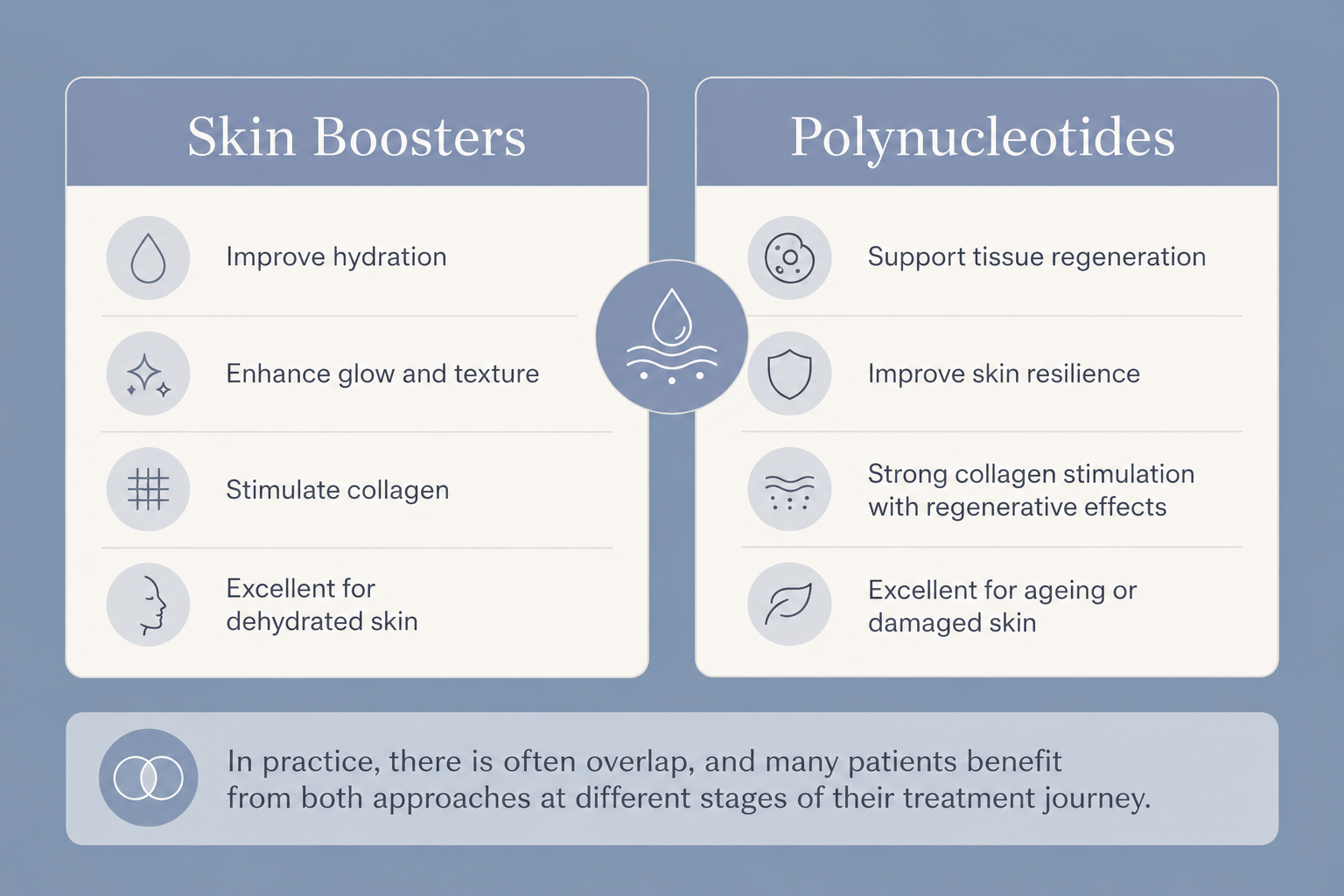
Traditional hyaluronic acid skin boosters mainly focus on restoring hydration within the skin. Better hydration improves the skin’s appearance, making it smoother, healthier and more radiant while also encouraging collagen production over time.
Polynucleotides, on the other hand, place greater emphasis on regeneration. Their primary role is to encourage the skin to repair itself, making them particularly beneficial where collagen loss and tissue quality have become the dominant concerns.
A simple way to think about it is:
Which treatment is better for ageing skin?
There isn’t a universal answer because skin ageing affects everyone differently.
For someone in their thirties with early dehydration and fine lines, a hyaluronic acid skin booster such as Profhilo® or Restylane Vital® skin boosters may be all that’s needed to restore skin quality.
However, if the skin has become noticeably thinner, crepey or less resilient, we would often look towards polynucleotides because their regenerative properties can help improve the skin’s underlying health as well as its appearance.
During consultations at Fountain of Youth, we assess factors including:
- Skin hydration
- Skin thickness
- Fine lines
- Elasticity
- Collagen loss
- Lifestyle factors
- Long-term treatment goals
These findings usually determine which treatment is likely to produce the best outcome.
Can skin boosters and polynucleotides be combined?
Yes, and in many cases they complement each other well.
Rather than viewing them as either/or treatments, we often build treatment plans that improve several aspects of skin health over time.
For example:
- Polynucleotides may be used initially to improve tissue quality and stimulate regeneration.
- Hyaluronic acid skin boosters can then maintain hydration and improve luminosity.
- Medical microneedling may be incorporated to further stimulate collagen production.
- Medical-grade skincare can help maintain and prolong results at home.
Because every skin concern is different, combination treatments are always personalised rather than following a standard protocol.
How many treatments will I need?
Most injectable skin quality treatments work best as a course rather than a single appointment.
Typically, two to three sessions spaced around four weeks apart allow collagen production and tissue regeneration to build gradually. Maintenance treatments are then recommended every six to twelve months depending on the product used and your individual skin.
One treatment can certainly improve the skin, but courses generally provide more consistent and longer-lasting results.
How long does it take to see results?
One of the biggest differences between skin boosters and treatments such as dermal fillers is that improvements develop gradually.
Hydration from hyaluronic acid skin boosters is often noticeable within the first few weeks, while collagen stimulation continues over the following months.
Polynucleotides also work progressively. Because they stimulate your skin’s natural repair processes, improvements usually become more noticeable as new collagen and healthier tissue develop.
Patients often describe the results as looking healthier, fresher and more rested rather than looking like they’ve had cosmetic treatment.
Which treatment is right for you?
Choosing between skin boosters and polynucleotides isn’t about selecting the newest treatment. It’s about understanding what your skin actually needs.
For milder dehydration, loss of radiance and early fine lines, we would usually begin with a hyaluronic acid skin booster.
Where collagen loss, thinning skin or reduced elasticity are more significant concerns, polynucleotides may offer greater long-term benefits.
In many cases, the most effective treatment plan combines both approaches over time rather than relying on a single treatment. That personalised approach often produces the most natural-looking improvements because hydration, collagen and skin quality are all addressed together.
Frequently Asked Questions
Are polynucleotides better than skin boosters?
Not necessarily. Polynucleotides are a type of skin booster with a greater focus on regeneration and rely on your body to use them appropriately. The best treatment depends on your skin condition and treatment goals.
Can skin boosters replace dermal fillers?
No. Skin boosters improve skin quality, hydration and collagen production but do not replace lost facial volume. Dermal fillers remain the preferred option where structural support or contouring is required.
Are skin boosters suitable for younger patients?
Yes. Many younger patients choose skin boosters to maintain healthy skin, improve hydration and help delay visible signs of ageing.
Do polynucleotides make you look different?
No. Polynucleotides work by improving the health of the skin rather than changing facial shape. Results are gradual and natural-looking.
Can I have microneedling with skin boosters?
Yes. At Fountain of Youth, skin booster treatments are combined with microneedling at the same appointment to further enhance collagen stimulation and overall skin rejuvenation.
Considering Skin Boosters or Polynucleotides?
If you’re thinking about improving your skin but aren’t sure which treatment is right for you, a professional consultation is the best place to start. By assessing your skin quality, hydration, collagen levels and the specific concerns you’d like to address, we can determine whether a skin booster, polynucleotide treatment or a combination approach is likely to deliver the best outcome.
At Fountain of Youth in Salisbury, every treatment plan is tailored to the individual rather than following a standard protocol. During your consultation, we’ll explain your options, answer any questions you may have and recommend the treatments most appropriate for your skin and long-term goals. If you’re ready to achieve healthier, more radiant skin with natural-looking results, book a consultation today and discover the treatment plan that’s right for you. We welcome patients from Salisbury, Wiltshire and the surrounding areas.